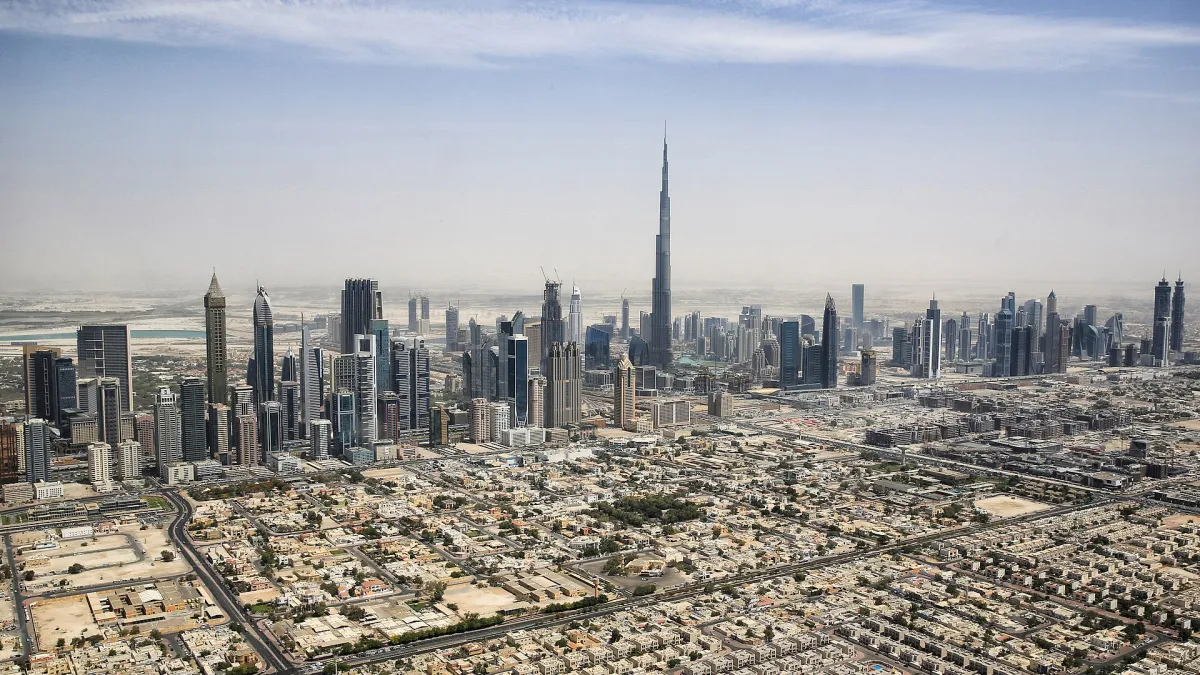
Dubai's prime market has reached the part of the cycle its promoters never put in the brochure: the handover. Through this autumn and into next year, the towers sold off-plan in the boom years are delivering, and the sales galleries have given way to snagging lists and completion cheques. The villas on the Palm that were flipped in the early frenzy have been resold, sometimes twice. A market that used to be all promise is becoming a market with a track record — and track records are where booms meet the word their promoters avoid.
The boom itself was real, and its foundations were more honest than sceptics admitted. A city that opened early after the pandemic, taxed nothing, offered ten-year golden visas to investors and professionals, and felt safe to Russians, Indians, Europeans and wealthy Arabs alike was always going to attract money. Prices on the Palm and in the villa districts doubled in short order. That part was not froth; it was repricing.
The pipeline arrives on schedule
Dubai's chronic condition is not demand. It is that supply here is constrained neither by geography nor by planning in the way it is in Hong Kong or London, and every developer in the city spent the good years doing what developers do: launching. The towers announced in 2022 and 2023, when the boom was loudest, are now handing over, and the payment plans that sold them — a deposit, instalments, a chunky balance on completion — are arriving at the chunky-balance stage.
This is the moment to watch. Off-plan buyers who intended to flip must find end users. Handover volumes step up quarter by quarter through the rest of the decade. Money, too, has a price again: with the US ten-year Treasury yielding around 5%, the dirham's dollar peg imports a financing cost that turns every completion balance into a genuine decision rather than a formality. None of this means a crash; it means the market is now discovering how much of the demand of the boom years was for Dubai, and how much was for the trade.
Apartments and villas are different stories. Towers can multiply along a highway; shoreline cannot. The genuinely scarce stock — Palm fronds, Jumeirah Bay Island, the established villa communities — has a supply argument that a forty-storey tower in a new district does not.
What the villa districts trade on
Ask a Palm agent what sells and the answer is a list of nouns: plot, view, beach, berth. The fronds trade on position on the frond, the age of the villa, and whether the skyline view faces the marina or the open sea. Emirates Hills trades on the golf course and on being old Dubai money. Jumeirah Bay trades on being the newest scarcity, an island of plots with a hotel at one end.
These markets are thin and lumpy, and their prices are set by the last comparable sale, which may be months old. That cuts both ways: in a strong market it drags valuations up in steps; in a weak one the screen goes quiet rather than red. A buyer this deep into a bull run should treat the absence of comparables as information, not as reassurance.
The questions at the handover
The cautious buyer's checklist is not complicated, but it is unglamorous, which is why it gets skipped in boom years. Who is the end user for this specific unit — not for Dubai in general? What does an identical unit actually rent for today, rather than in the agent's forward estimate? What is the developer's record on delivery dates and build quality, and what do the service charges look like once the building is handed over and the sales team has left?
Above all: if this had to be sold in a bad year, who is the buyer? On the Palm, there is an answer. In a tower that is one of eight identical towers, the answer is whoever buys the cheapest of eight identical units, and that is a different proposition entirely.
The honest arithmetic of a real city
Dubai's historical corrections have been fast and deep, and nobody who sat through its last two busts has forgotten it. The bull case this time rests on something sturdier than oil: population growth, corporate relocations, a decade of institutional building, and a tax environment that its competitors keep improving for it. The bear case is simpler: a great deal of what was sold off-plan was sold to people who will never live in it.
Both can be true at once, and in different segments they will be. The city's prime stock — the shoreline, the golf course, the island — now behaves like prime stock elsewhere: scarce, internationally wanted, expensive to carry and rarely forced to market. The commodity towers will do what commodity towers do. A buyer who can tell those two apart, and who asks the dull questions, can still buy Dubai this late in the run without buying the top. The market has grown up. It is allowed to have a cycle now — and the handover ledger through 2027 and 2028, not the launch calendar, will decide how gentle this one is.