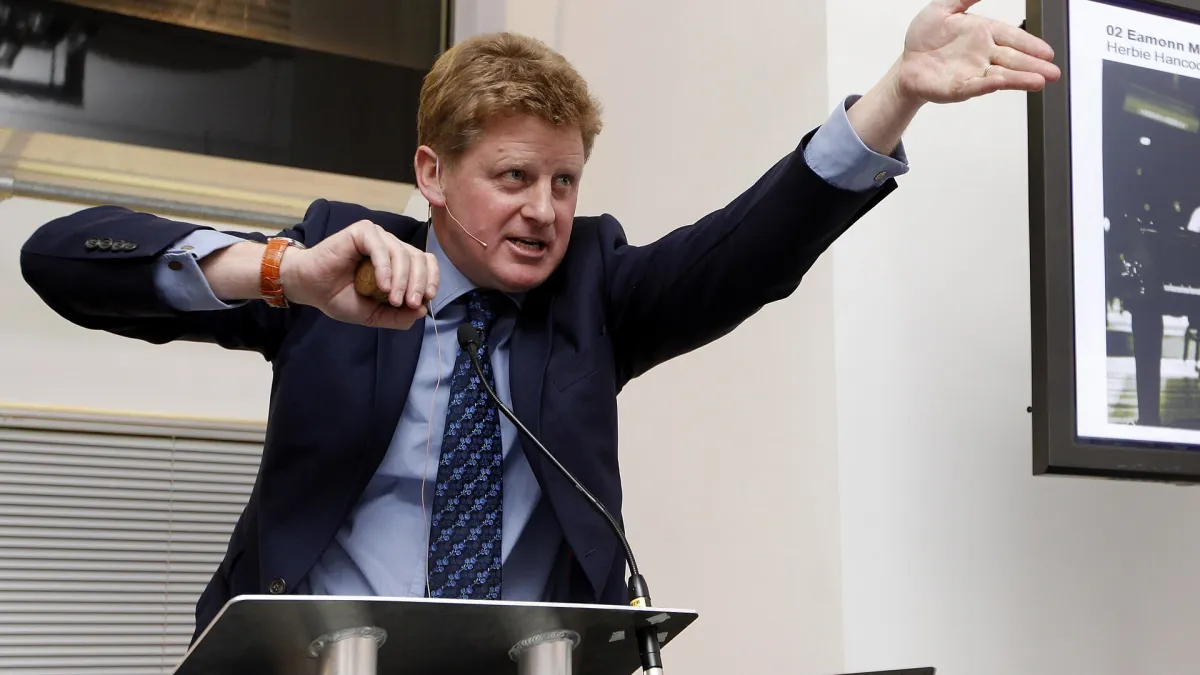
The disclosure that matters most to a seller arrived quietly this month. Sotheby's symbol key, revised on 13 September, sets out which lots carry a minimum-price guarantee and which carry an irrevocable bid — the two marks that show where the house, or a party standing behind it, has taken a position before the first bid. The same page does not say what either arrangement cost the person who consigned the work. That figure lives in the contract, and the contract is not published.
Almost everything a buyer meets at auction is fixed in advance: the premium schedule, the conditions of sale, the reserve convention, the symbols themselves. The seller's side runs the other way. It is negotiated one consignment at a time, and it is the only part of the process with no published price list.
What the houses publish, and what they carve out
Sotheby's consignment-terms page, last revised on 13 April 2026, names the fee categories a seller pays — commission, damage and liability fees, marketing and other promotional costs — and gives a rate for none of them, sending sellers to a specialist instead. Christie's says the seller's commission is agreed at consignment and varies.
The one seller schedule Sotheby's still publishes is a rate chart from 2024: 10 per cent of the first $500,000 of hammer price per lot, capped at $50,000; waived where the consignment's low estimate passes $5 million; waived plus 40 per cent of the buyer's premium above $20 million; bespoke above $50 million; and a 2 per cent success fee on any lot that beats its high estimate. Then comes the line that does more work than the table: "Seller terms apply for all auction consignments of non-guaranteed property."
Guaranteed property sits outside that grid. What a house charges a consignor for the guarantee — and what it pays a third party to carry the risk — is on no public schedule this desk could find.
What a floor costs, and who pays for it
Christie's spells the arrangement out in the special notice it attaches to guaranteed lots. The house "has a direct financial interest in the outcome of the sale of certain lots consigned for sale," it says. "This will usually be where it has guaranteed to the Seller that whatever the outcome of the auction, the Seller will receive a minimum sale price for the work. This is known as a minimum price guarantee." The same notice concedes the exposure: the house "is at risk of making a loss, which can be significant, if the lot fails to sell."
Sotheby's marks the same thing with a circle. The seller, its symbol key says, "has been guaranteed by Sotheby's a minimum price from one auction or a series of auctions, regardless of the outcome," and Sotheby's "has a direct financial interest in the outcome of the sale of such lots."
The floor is not free, and the price is paid out of the upside. A preliminary offering circular filed with the US Securities and Exchange Commission on 27 January 2026 by Masterworks Vault 6, a company that buys art as a consignor, describes the trade plainly: in exchange for a guaranteed minimum price, the consignor "agrees, if the final sale is in excess of the guaranteed amount, to pay the auction house a certain percentage of sale proceeds above the guaranteed amount." The same filing says the economics receivable by a seller "are less favorable if the work is subject to a pre-auction guarantee," and puts net pre-tax proceeds at roughly 80 to 90 per cent of the published sale price.
A floor is insurance, and insurance is priced against the alternative. With the ten-year Treasury at 4.949 per cent and gold at US$4,361.50 an ounce (desk ticker, 17 September), the alternative is carrying the object another season.
The bid that cannot be withdrawn
The second symbol is the risk transfer. Sotheby's says an irrevocable bid is "executed during the sale at a value that ensures that the lot will sell": absent higher bids, the irrevocable bidder buys at the level of the bid; if higher bids appear, that bidder may, but need not, go above it. The bidder "may be compensated for providing the irrevocable bid by receiving a contingent fee, a fixed fee or both," and where the bidder wins, that fee is netted against the purchase price, so that "the purchase price reported for the lot will be net of any such fees." Sotheby's adds that a shareholder may be an irrevocable bidder, who may know the amount of the guarantee.
Christie's version is the same in shape. A third party agrees before the auction to place an irrevocable written bid; if no higher bid arrives, it buys at that level and "takes on all or part of the risk of the lot not being sold." Christie's compensates it only "provided that the third party is not the successful bidder" — by a fixed fee or an amount calculated against the final hammer price. Where the third party does end up with the work, it pays the hammer price and the buyer's premium in full, like any other buyer.
Three consequences are worth stating slowly. A guaranteed lot with an irrevocable bid cannot be bought in. It also will not be knocked down to a stranger at the reserve, because the book already holds a bid the room has to beat. And a bidder compensated only when it does not win is bidding to a different arithmetic than a collector is.
The enhanced hammer
The industry has a name for the other half of a large consignment's economics, and it appears in the same SEC filing. "For high value items auction houses often waive the sales commission and rebate a portion of the buyer's premium to the consignor, which is commonly referred to in the industry as an 'enhanced hammer.'" That is the arrangement consignors are usually negotiating for — a reduction in what the published schedule would otherwise take. On a guaranteed lot it arrives alongside a guarantee fee, an overage share, or both, and none of those three terms is reported publicly.
How much of the market runs this way
Third-party guarantee coverage reached a record 73 per cent of the hammer total in New York's Modern and Contemporary evening sales in May 2025, according to the auction-data firm Pi-eX, whose figures the Observer published on 8 July 2025. Christie's led at 83 per cent, Phillips at 65 and Sotheby's at 63. The Art Newspaper, reporting the two houses' half-year figures on 15 July 2026, described the "near ubiquitous use of guarantees at the top level." The Art Basel and UBS Art Market Report, published on 12 March 2026, put public auction sales for 2025 at $20.7 billion, up 9 per cent, and private sales through the auction houses down 5 per cent to just under $4.2 billion.
Sotheby's full-year 2025 release, published on 18 February 2026, gives consolidated sales of $7.1 billion, revenue of $1.4 billion and net debt of $818 million — and no figure at all for the guarantees outstanding against that book. Christie's half-year release of 15 July 2026 reported a 91 per cent sell-through rate and no guarantee exposure either. Guarantees cluster where the value is. The risk behind them is not a reported number.
What to settle before the estimate is printed
The negotiation is short and specific. The floor, and whether it covers one sale or a series. The overage split above it. Whether the guarantee is the house's alone or shared, and whether the consignor may refuse a particular counterparty. The commission treatment of the consignment as a whole, which is where the enhanced hammer lives. The marketing budget and the damage-and-liability line that Sotheby's own page names. The settlement clock. And the question that decides the shape of everything else: if the lot is bought in, who owns it afterwards.
None of those numbers will appear in the catalogue. The symbols will.
The autumn catalogues are being assembled now, and the circles and brackets will be printed in them again. Everyone in the saleroom will see a result. The consignor will see the invoice. The two documents describe the same sale, and the distance between them was settled in September, before anyone in the room was allowed to bid.