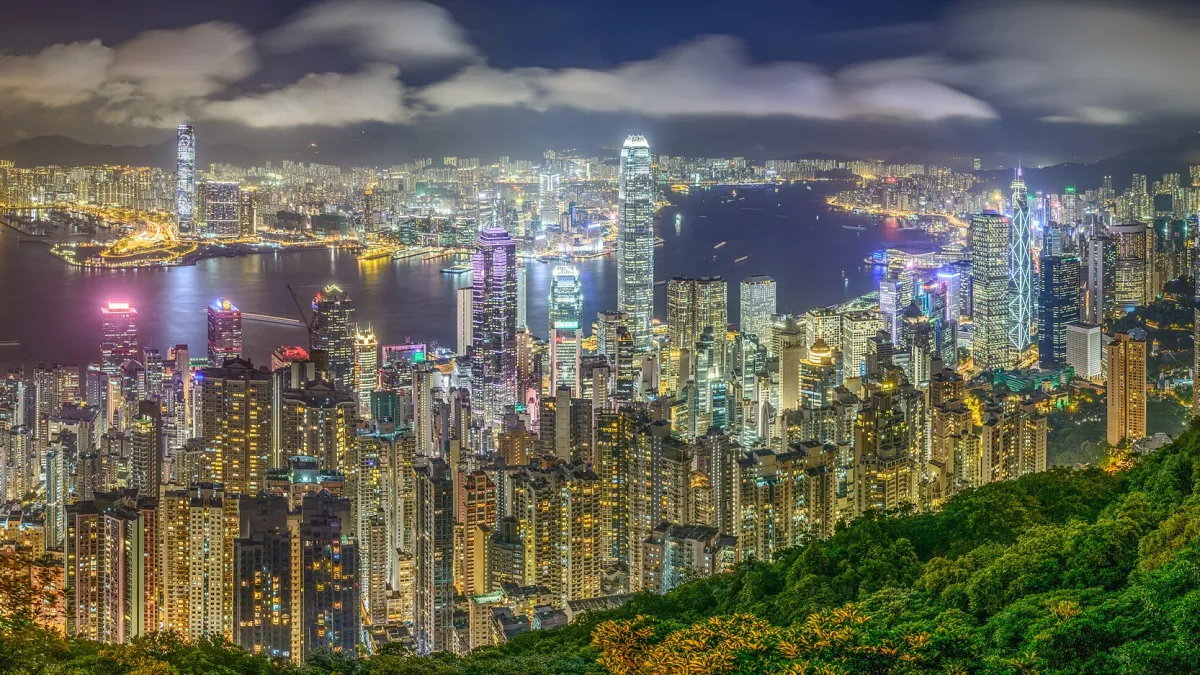
On the Peak, the most revealing sound in the property market is silence. A senior agent who has worked the district for two decades can go a whole quarter without a single instruction worth the name, and she will not be embarrassed to say so. There are streets up here — Severn Road, Pollock's Path, the upper reaches of Mount Kellett — where nothing has traded in years, and where an asking price, when one finally appears, is closer to an opening bid in a negotiation between people who do not need to finish it.
That is the first thing to understand about Hong Kong's ultra-prime districts: they are a supply problem wearing the costume of a demand story. The conventional account — Chinese money, family offices, the revived investor visa — is about buyers. But buyers come and go with the cycle, and the Peak's prices have never behaved cyclically in the way the mass market does. The explanation sits on the supply side, and it is close to absolute.
The mathematics of almost none
The Peak is a finished neighbourhood. The buildable plots were laid out when Hong Kong was a different city, and between country-park boundaries, slope zoning and the sheer awkwardness of building on the hillside, there is no new land of any consequence. What changes hands is what exists: a fixed stock of houses and a slightly larger stock of low-rise apartments, most of it assembled decades ago.
Redevelopment adds little. An old block can be pulled down and rebuilt as a small number of very large houses, and a few have been. But the process takes years, planning is unforgiving, and the arithmetic only works for owners who are already wealthy. Net new supply, in any year that matters, rounds to zero.
The Southside — Repulse Bay, Deep Water Bay, Shouson Hill — tells the same story with a sea view. Scarcity here is not a marketing adjective. It is a physical fact enforced by geography and planning law, and it is why these districts sit in a different analytical category from the rest of Hong Kong housing.
Owners with no reason to sell
The second fact is about the sellers, or rather the absence of them. The typical Peak owner is a family that has held the house for a generation, or a tycoon for whom the carrying cost is a rounding error, or a company structure that treats the property as a store of value with a view. None of these sellers faces a margin call. Distress, in the ordinary property sense, does not reach this altitude.
When houses do come to market, the causes are usually dynastic rather than financial: a death, a divorce, a family deciding that three generations is enough. Corporate disposals happen — a conglomerate tidying its balance sheet — but even those sellers can wait. The result is a market where the offer side is rationed by choice, not by price.
This is why the Peak does not do distress. In a downturn the mid-market cuts; the Peak simply stops trading. Owners withdraw rather than discount, and the district enters one of its long silences. An agent who measures her year in instructions learns to read these silences as the market's true signal.
Who actually buys
The marginal buyer has changed over the decades — British taipans, then Hong Kong's manufacturing fortunes, then mainland wealth, and lately the family offices the government has courted. The revived capital-investment visa, relaunched in March 2024 with HK$30 million of permissible assets and only a capped slice allowed into property, brings a slow drip of applicants who will, in time, want houses.
What has not changed is the buyer's psychology. Nobody purchases on the Peak for yield. The purchase is positional: a particular street, a particular gate, sometimes a particular house that the buyer has watched for years. Buyers of this kind are price-insensitive in one direction and stubborn in the other — they will overpay for the right asset and walk away from the merely available one.
That matters for how you read any headline figure. A record price on the Peak usually tells you that one determined buyer finally met one willing seller. It says almost nothing about what the house next door is worth, because there may be no next transaction for years.
What the volume tells you
Serious watchers of this market ignore asking prices entirely. An asking price on the Peak is an aspiration published to test the water; the Land Registry's completed sales are the only data that count. And there, the signal is volume. Two or three genuine house sales in a quarter is a healthy market. A quarter with none is not a crash — it is a refusal.
For anyone trying to time an entry, the practical advice is unfashionable: choose the street, decide the house, retain the agent, and wait. Buyers who need a transaction on a schedule should look elsewhere, because this market does not honour schedules. The money that wins here is patient money, and it has usually been ready for longer than it expected.
The next few years will test that patience from the demand side. Family offices are still arriving, the visa applicants are still maturing into purchasers, and none of it will create a single new plot on the hill. The supply side is settled for good. The Peak will go on doing what it has always done: nothing, expensively — and being right more often than the people who call it overpriced.