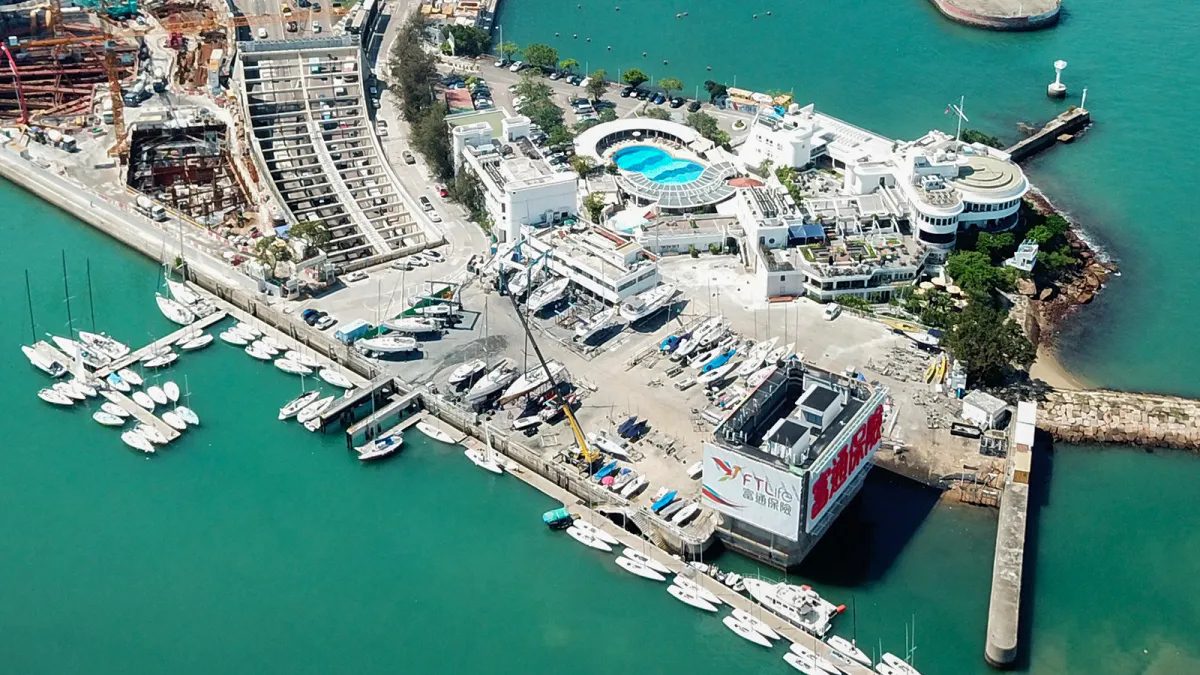
Hong Kong prices its water, if you ask the right club. Hebe Haven Yacht Club, at Pak Sha Wan in Sai Kung, publishes a monthly rate for every berth and mooring it lets — HK$1,757 for the smallest mooring band, HK$18,479 for the largest walk-on berth — and says on the same page that all 53 berths, all 212 moorings and all the hardstanding are full, each with a member waiting list. What it does not publish is the length of those lists. The dates are public, in three files, and they do work the prose declines to.
What the rate card prices
The marina holds 53 walk-on berths, sized 12m, 15m and 18m, priced at HK$10,670, HK$14,692 and HK$18,479 a month. Multiplied out, the 12-metre berth costs HK$128,040 a year and the 18-metre HK$221,748; divided by the printed lengths, 40, 50 and 60 feet, the three run at HK$3,201, HK$3,526 and HK$3,696 per foot per year. The largest is 15.5 per cent dearer per foot than the smallest: the marina charging for the pontoon, not the water.
The 212 moorings in Pak Sha Wan Bay take boats from 5m to 18m in six bands: MF1 at HK$1,757 for 5–8m, MF3 at HK$2,396 for 9.01–11m, MF6 at HK$4,118 for 17.01–18m — HK$28,752 and HK$49,416 a year. Compare the two lists for the same hull: HK$10,670 ÷ HK$2,396 = 4.45, and HK$18,479 ÷ HK$4,118 = 4.49. A walk-on berth costs about four and a half times a mooring, whatever you own. It buys what a mooring cannot: stepping aboard instead of signalling for the sampan.
The dates on the lists
Three files carry the queue: the berth list, the mooring list and the hardstand list, all dated 31 October 2025. Each carries positions, membership account codes and a date column — no names. The club labels that column only "DATE"; the arithmetic below is the file's own.
The berth list runs to 45: 17 for the 12-metre berths, 18 for the 15-metre, 10 for the 18-metre. The top of the 15-metre list carries the date 8 October 2011 — 14 years and 23 days against the file's own date, and 14 years and 11 months if that entry is still live this week. The 12-metre list is headed by 7 April 2015 and its last entry is dated 1 December 2022: no 12-metre application joined in the two years and eleven months before the club posted it. The 18-metre list is headed by 7 April 2016.
The mooring list is deeper and more uneven: 93 places. The band from 11.01m to 14m holds 47 of them, headed by 12 March 2017 and tailed by 28 September 2025, a month before the file went up. The band below it, 9.01–11m, holds 15, and every one of those applications is dated in 2025, the earliest on 15 January. The 5–8m band is empty.
Two centimetres separate those behaviours. The card splits its moorings at 11 metres, and the dearer band costs HK$7,104 a year more. A 10.99m hull — the length on the specification sheet of a 2016 Hanse 385 listed in Hong Kong — sits in the cheaper band and in a queue of 15 that is entirely from 2025. Two centimetres longer joins a queue of 47 headed by a 2017 date.
The hardstand list holds 13 places, three of them jet skis; its oldest entry is dated August 2020 — a five-year wait for a rack costing HK$1,775 a month.
A queue one account can hold six times
Add the three files and they contain 151 places. Count the distinct membership codes and there are 106. Thirty-two accounts hold more than one position, and between them 77 of the 151; one account appears six times, across the three berth lists and three mooring bands. Twenty-one appear on two or more of the three files.
Nothing in the documents forbids this: a member may stand for a berth, a mooring and a rack at once, and a place costs a refundable deposit. On the club's own forms that deposit is three months' rent on a new contract. The queue's true length sits between 106, the members in it, and 151, the places they hold. The club publishes neither figure.
The berth queue of 45 is 85 per cent of the 53 berths that exist; the mooring queue of 93 is 44 per cent of 212; the hardstand queue of 13 is at most 13 per cent of the bays the club calls over 100. The scarcest thing at Pak Sha Wan is not the water. It is the pontoon.
Five years, in writing
The Royal Hong Kong Yacht Club takes the other approach. Its Marine Fees page is dated 1 August 2026 and prices moorings across 12 length bands and four locations. The cheapest published line is Middle Island at HK$2,485 a month for 5–8m, HK$29,820 a year; the dearest is Causeway Bay at HK$10,180 for a 28m mooring. An 11–14m hull is HK$5,120 at Causeway Bay, HK$3,205 at Shelter Cove.
What it publishes that Hebe Haven does not is a duration: all moorings full, no temporary use for non-members at any price, and a waiting list "currently running at around five years, for all sizes and location of moorings". Each application carries a refundable deposit of one month's fee, and a member may apply for different sizes at different locations — several places in several lines, no way to buy a better position in one.
The fee, the club says, covers the lease of the empty space, charged by the Marine Department, the equipment with maintenance, insurance and ferry transport, and a pontoon to lie against. A service billed monthly, not an asset. Neither club describes what a berth is worth to the member who gives one up; neither sells one.
What a hull asks, against what the water costs
Water is priced by a club; hulls by whoever is selling. A Hong Kong brokerage board carries a Sanlorenzo 57 built in 1991, 17.7m, asking HK$680,000, and a Hanse 385 built in 2016, 10.99m, asking HK$1,750,000. The same board marks an Azimut 55 down from HK$2,800,000 to HK$1,700,000.
Set the Sanlorenzo against the berth it would occupy. At HK$18,479 a month — HK$221,748 a year — the asking price of a 35-year-old 17.7m motor yacht equals 3.07 years of the water it floats on; three years of berth, HK$665,244, is 98 per cent of the ask. On the MF6 mooring at HK$49,416 a year, the ask buys 13.76 years. The Azimut's HK$1,100,000 discount is 6.24 years of the 15-metre berth at HK$176,304.
Both are asks; the difference is disclosure. The club's rates are published and identical for everyone; a hull's value is one seller's opinion, and Hong Kong publishes no record of what a used boat actually sold for. The club also publishes the procedure — its forms call it grandfather rights — for moving a berth, a mooring or a pontoon to a new owner when a member sells the boat: three forms, the new owner's documents, the deposit moved to the new account, and the Operations Committee's approval. A queue position can travel with a hull, and what that adds to the price is on no document either side publishes.
The only citywide figure this month is a claim, not a record. At a Kwun Tong yacht-economy seminar on 11 September, the legislator 鄭泳舜 put Hong Kong's registered pleasure fleet at about 12,000 vessels and its compliant berths at fewer than 5,000, as reported by Hong Kong Commercial Daily — a public figure's statement, not a document this desk read.
The number to watch
Hebe Haven's three files carry one date, 31 October 2025. When the club replaces them, the year at the head of the 12-metre and 15-metre berth lists answers the only question the card leaves open. If 2011 becomes 2012, a berth changed hands within the year and the list is a queue in the ordinary sense. If 2011 is still 2011, it is a register of people waiting for something that has stopped happening, and their rate is whatever the club's next card says. A duration and a date are different kinds of promise: one can be revised quietly, the other has to be reprinted. For a reader weighing a boat, the date column is the better evidence, and it is already public.