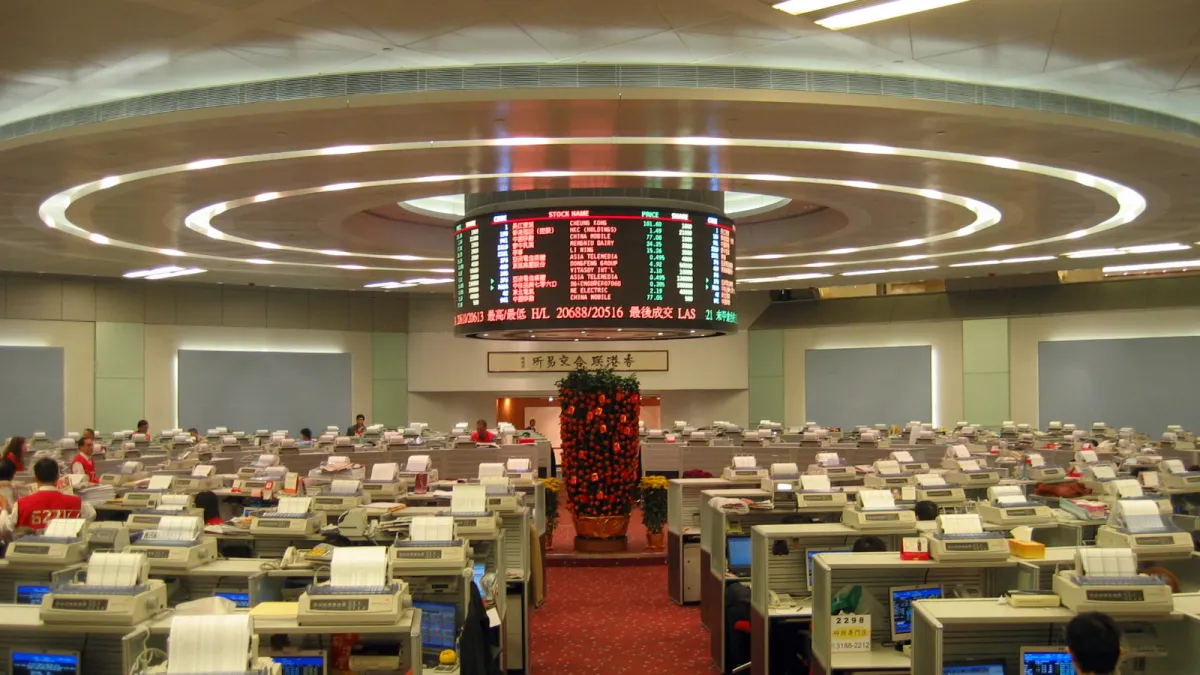
Every trading day the number goes up in lights along the harbour, and the men smoking beneath the brokerages in Central can call the open without looking at a phone. What they are reading is routinely described abroad as a gauge of China. It is nothing of the sort, and the gap between what the Hang Seng Index is and what the world thinks it is explains most of the mistakes foreigners make with it.
What the index actually holds
Start with the constituents. The largest bloc is financials: HSBC and AIA, Hong Kong Exchanges itself, and the Hong Kong-listed arms of the mainland state banks, which arrive in the index carrying Beijing's dividend policy in their luggage. Then the platforms — Tencent, Alibaba, Meituan, Xiaomi — the consumer-internet franchise that global capital once flew to New York to buy. Property, the engine of the index for two generations, has been reduced to a supporting role by the mainland developer defaults and the quiet repricing of everything built on top of them.
What remains is a hybrid: an index of Chinese corporate earnings, priced in a currency pegged to the US dollar, under Hong Kong law, with interest rates imported from the Federal Reserve. No other major market combines those genes. It is China's earnings cycle crossed with America's rate cycle, and it confounds anyone who models it as purely one or the other.
The southbound bid
The structural change of the past few years is who buys. Through Stock Connect, mainland investors now buy Hong Kong-listed shares directly, and southbound flows have run at record levels through much of the past two years. The motivation is arithmetic, not patriotism. Mainland deposit rates are low, the property market that absorbed household savings for twenty years is impaired, and the same state banks a Shanghai saver knows at home are listed in Hong Kong at lower valuations with higher dividend yields.
This changes the marginal price-setter. A market once driven by foreign risk appetite now has a persistent domestic bid beneath its cheapest, highest-yielding names. The AH premium — the gap between mainland and Hong Kong prices for the same company — has become the dial to watch: when it widens, southbound money arrives to narrow it. Foreign funds that sold Hong Kong as a China proxy have increasingly sold to mainland savers who bought it as a yield instrument.
The proxy mistake
The standard foreign error is to treat Hong Kong as China's stock market with better coffee, and to buy or sell it as a levered expression of a view on Beijing. That misses the plumbing. The peg means no currency risk for dollar-based holders but also no monetary autonomy; dual-primary listings and the migration of American depositary receipts back to Hong Kong have concentrated the China technology franchise here precisely as foreign benchmarks reduced it. The index is becoming more Chinese in the identity of its buyers and more Hong Kong in the mechanics of its pricing.
It also misses the governance spread. An H-share state bank and a mainland property developer are both "China exposure" in a risk report and almost opposite assets in a portfolio. Hong Kong's market prices that distinction more honestly than the headlines do, which is one reason the index so often refuses to follow the narrative assigned to it.
The yield lens
Ask a Central broker how the index is valued and the answer comes back in dividend yield — against fixed deposits, against mortgage rates, against the yield on the mainland bonds a Connect investor might otherwise hold. The Hang Seng has long yielded more than almost any developed-market index, and Beijing's pressure on state firms to raise payout ratios has made the cash return a policy instrument as much as a corporate choice.
That lens sets the questions for the year ahead. Does the southbound bid keep growing until it sets prices outright, turning Hong Kong into an onshore yield market with an offshore address? Do Connect's eligible lists keep widening — renminbi counters, more mid-caps, more instruments? And does the dividend policy survive a downturn in state-bank earnings? Answer those, and the index stops being a riddle. It becomes what the locals always said it was: a yield with a view.